
round side table - white oak


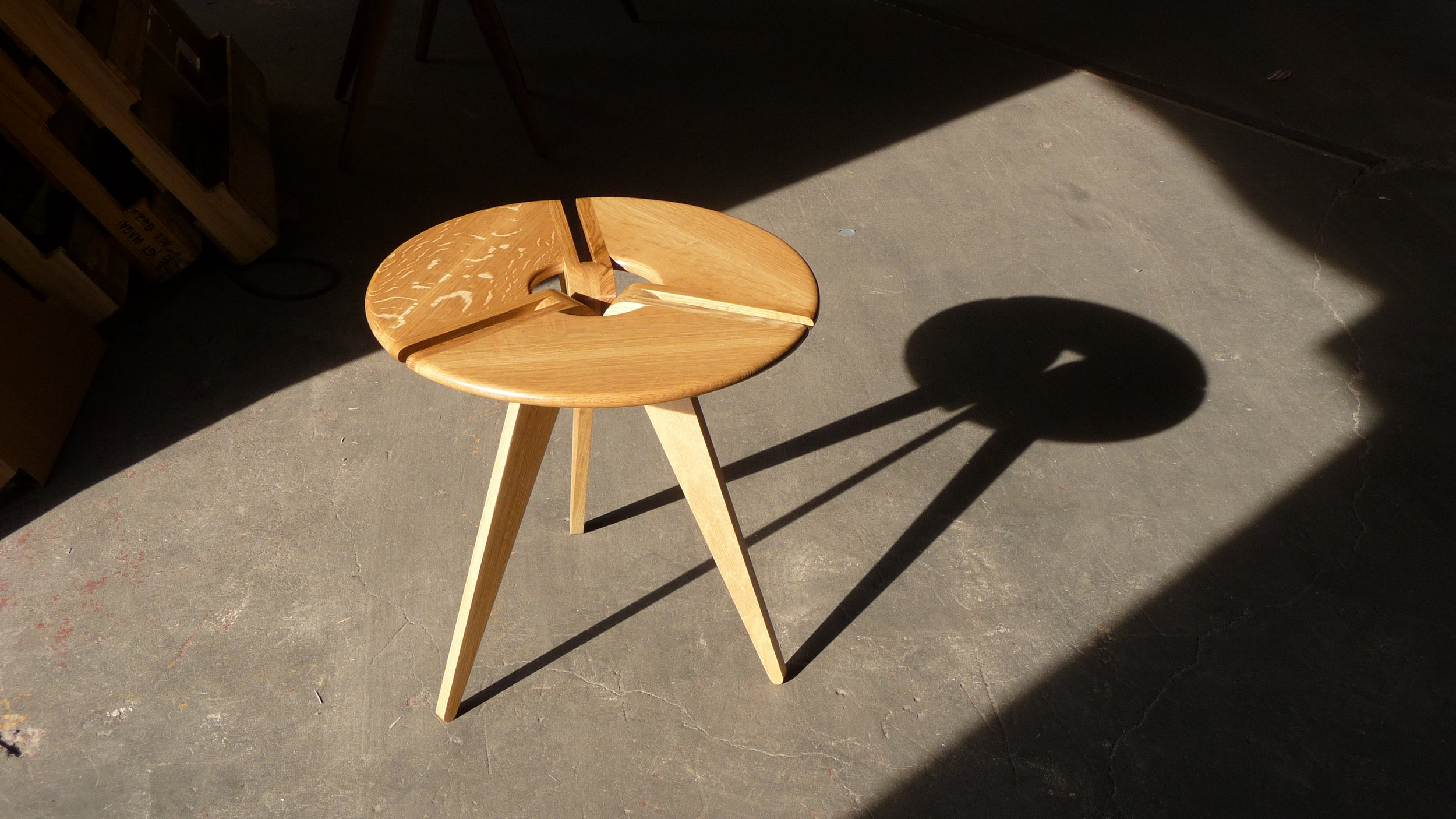
round side table - white oak
W 22 x H 16
W 22 x H 22 (as shown)
W 28 x H 22
W 28 x H 28
PETALPLY / SUB-SERIES ONE
The Round Side Table is PetalPly reduced to one of its clearest expressions. Three shaped structural components rotate around a central dowel to create the base, while the circular top continues the geometry established by the joint below.
The table demonstrates the central PetalPly idea: legs, arms and stretchers are not treated as conventional furniture parts but as related components generated from a common profile. Their smaller half-round ends expand into larger circular knuckles and assemble around a structural dowel/tenon.
Available at several heights and diameters, the same small structural system moves between occasional table, side table and compact display surface. The result is less a single fixed design than one application of a repeatable construction language.
PetalPly -
sub-series one (tables and a chair)
System proposition: JOINT BECOMES SYSTEM. PetalPly begins with the knuckle joint: shaped structural components with smaller half-round ends expanding into larger circular knuckles, rotated and layered around a structural dowel/tenon. The joint becomes both construction and visual identity.
knuckle joint as sculptural structure
PetalPly begins with a joint. Tapering solid-wood components narrow toward a half-round end and gather around an oversized dowel. Their alternating grain and layered construction create a kind of muscular alpha plywood: not sheet material pretending to be solid wood, but solid wood deliberately behaving like ply. The rounded knuckle allows the Petals to rotate around the dowel while making the connection itself the visual center of the structure.
three scales
The system is governed by proportion. Component thickness establishes the starting unit; the dowel is approximately twice that thickness; the Petal grows to roughly four times the scale. Working in three sizes lets the same language move from smaller furniture into dining, work and larger table applications without inventing a new vocabulary each time.
power of the penetration
Openings in the tops are not decoration applied afterward. They reveal the structure underneath, allow light and space to pass through, blur the distinction between top and base, and provide expansion space for solid-wood movement. PetalPly therefore establishes several ideas that keep returning throughout New Breed: visible joinery, repeated components, proportional rules, structure as ornament and the deliberate use of negative space.


